What is BTCUSD and why does it matter for traders?
BTCUSD represents the price of Bitcoin quoted in US dollars, showing how much one Bitcoin is worth in USD. It is one of the most traded cryptocurrency pairs globally because it reflects both crypto demand and the strength of the US dollar.
BTCUSD is the trading pair that shows how many US dollars are needed to buy one Bitcoin. It is widely used by traders to speculate on Bitcoin price movements, hedge exposure, and analyze the broader crypto market relative to traditional currency value.
Key takeaways
- BTCUSD is the most popular Bitcoin trading pair globally
- It reflects both cryptocurrency demand and USD strength
- Traders use it for speculation, hedging, and market analysis
- It is highly volatile compared to traditional forex pairs
- Both technical and fundamental factors influence its price
What is BTCUSD
BTCUSD is a financial trading pair that represents the exchange rate between Bitcoin and the US dollar. It tells traders how much USD is required to purchase one Bitcoin at a given moment.
In practical terms, if BTCUSD is trading at 70,000, it means 1 Bitcoin equals 70,000 US dollars.
This pair is commonly available on crypto exchanges and CFD trading platforms. It behaves similarly to forex pairs like EURUSD but is typically more volatile due to the nature of cryptocurrencies.
BTCUSD is often considered the benchmark for the entire cryptocurrency market because Bitcoin remains the dominant digital asset by market capitalization.
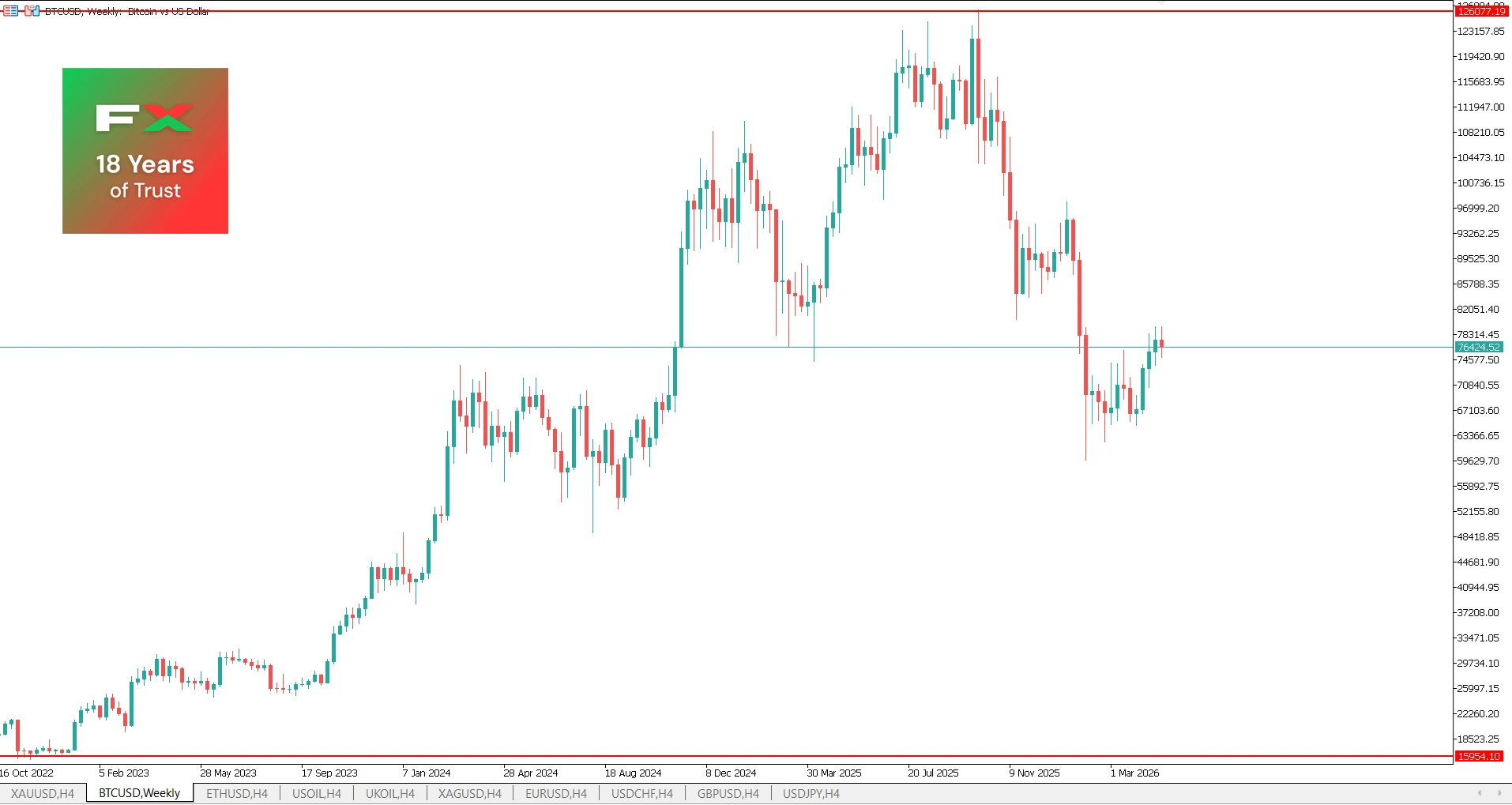
Historical Background or Origin of BTCUSD
BTCUSD emerged shortly after Bitcoin was introduced in 2009 by its pseudonymous creator, Satoshi Nakamoto. In its earliest phase, Bitcoin had no established market price, and trades were conducted informally between individuals on online forums and niche communities. The first known real-world valuation placed Bitcoin at less than one cent, reflecting its experimental nature at the time.
As cryptocurrency exchanges began to appear, BTCUSD evolved into a standardized trading pair, allowing participants to measure Bitcoin’s value against the world’s dominant fiat currency. This pairing quickly became the benchmark for pricing across the entire crypto market.
Key milestones in BTCUSD history
- 2009: Bitcoin network launched, no formal BTCUSD price exists yet
- 2010: First recorded BTCUSD exchange rates; Bitcoin trades below $0.10
- 2010: First real-world purchase using Bitcoin (10,000 BTC for two pizzas)
- 2013: Bitcoin reaches $1,000 for the first time, attracting global attention
- 2017: Major bull run pushes BTCUSD near $20,000, driven by retail interest
- 2018: Significant correction brings BTCUSD below $4,000, highlighting volatility
- 2020: Institutional interest begins accelerating, supported by macroeconomic uncertainty
- 2021: BTCUSD surpasses $60,000 as institutional and corporate adoption increases
- 2022: Market correction influenced by tightening monetary policy and reduced liquidity
- 2024: Bitcoin halving event reinforces long-term supply constraints narrative
- 2025–2026: Institutional participation, ETFs, and macroeconomic factors become dominant drivers
Over time, BTCUSD has transitioned from a niche, speculative asset into a globally recognized financial instrument. Its price is now influenced not only by crypto-specific developments but also by broader economic forces such as inflation, interest rates, and global liquidity. This evolution has made BTCUSD a key bridge between traditional finance and the digital asset ecosystem.
Bitcoin (BTC)
Bitcoin is a decentralized digital currency created to function without central authority. It operates on blockchain technology, where transactions are verified by a network of computers.
Key characteristics of Bitcoin:
- Limited supply capped at 21 million coins
- Decentralized and not controlled by any government
- Transparent transaction history via blockchain
- Often referred to as digital gold
Bitcoin’s scarcity and global accessibility are major reasons why it is paired with the US dollar for valuation.
United States Dollar (USD)
The US dollar is the world’s primary reserve currency and is widely used in global trade. It is issued and regulated by the Federal Reserve.
Key characteristics of USD:
- Highly liquid and globally accepted
- Influenced by interest rates and economic policy
- Considered a safe-haven currency during uncertainty
In BTCUSD, the USD acts as the benchmark for measuring Bitcoin’s value, making the pair a bridge between traditional finance and digital assets.
Working Mechanism of BTCUSD
BTCUSD works through supply and demand dynamics. When demand for Bitcoin increases, the price rises. When selling pressure increases, the price falls.
Pricing Logic
BTCUSD price is determined by:
- Buyers willing to pay a certain price
- Sellers willing to accept that price
- Liquidity available in the market
Example
If many traders believe Bitcoin will rise, they buy BTCUSD, pushing the price upward. If traders expect a decline, they sell, pushing the price down.
Market Structure
BTCUSD can be traded in two main ways:
- Spot trading: buying actual Bitcoin
- CFD trading: speculating on price movements without owning the asset
Benefits or Advantages of BTCUSD
BTCUSD offers several advantages for traders compared to traditional assets, especially for those looking for flexibility, volatility, and exposure to emerging markets. Understanding these benefits helps traders decide whether BTCUSD fits their trading style and risk tolerance.
High Volatility
BTCUSD is known for its significant price movements, often exceeding those seen in traditional forex pairs or stock indices. While major forex pairs may move less than 1 percent per day, BTCUSD can experience swings of 5 to 10 percent or more within the same period.
This volatility creates more frequent trading opportunities. Traders can benefit from both short-term price fluctuations and long-term trends. For example, a move from 60,000 to 63,000 represents a 3,000-point opportunity, which is substantial compared to most traditional markets.
However, this advantage requires disciplined risk management, as volatility increases both potential rewards and potential losses.
24/7 Market
BTCUSD operates continuously without closing hours, unlike forex markets that close on weekends or stock markets with fixed trading sessions.
This provides several practical advantages:
- Traders can react instantly to global news and events
- There is no need to wait for market openings
- Flexible trading schedules suit different time zones and lifestyles
For example, if major economic news breaks on a weekend, BTCUSD traders can immediately adjust positions, while traditional markets remain closed.
This constant availability makes BTCUSD particularly attractive to part-time traders and those who prefer trading outside standard business hours.
Accessibility
BTCUSD is one of the most accessible financial instruments in the world. Opening a trading account is relatively straightforward, and many platforms offer low minimum deposit requirements.
Key accessibility benefits include:
- No need for large capital to start
- Availability across multiple devices, including mobile
- Global participation without geographic restrictions
This allows traders from different regions to participate in the same market simultaneously, creating a highly active and liquid environment.
In addition, many platforms offer demo accounts, allowing beginners to practice trading BTCUSD without risking real funds.
Diversification
BTCUSD provides diversification by offering exposure to the cryptocurrency market, which often behaves differently from traditional financial assets such as stocks, bonds, or forex pairs.
For example:
- Bitcoin may rise during periods of currency devaluation or inflation concerns
- It can react differently to central bank policies compared to fiat currencies
- It is influenced by technology adoption and network growth rather than corporate earnings
Including BTCUSD in a trading portfolio can help reduce overall dependency on traditional market movements.
Diversification does not eliminate risk, but it can help balance exposure across different asset classes, especially during periods of uncertainty in global financial markets.
Disdvantages of BTCUSD
Despite its advantages, BTCUSD also comes with notable risks that traders need to understand before entering the market. These disadvantages are closely tied to the same features that make Bitcoin attractive, particularly volatility and global accessibility.
High Risk
BTCUSD is considered a high-risk trading instrument due to its extreme price fluctuations. While volatility creates opportunities, it also increases the likelihood of significant losses, especially when using leverage.
For example, a 5 percent move against your position can quickly result in a large loss if risk is not properly controlled. Sudden price drops of thousands of dollars within hours are not uncommon in the Bitcoin market.
This makes risk management essential. Without proper stop-loss placement and position sizing, traders can lose capital quickly.
Market Uncertainty
BTCUSD is heavily influenced by sentiment and external events, which can make it unpredictable. Unlike traditional markets that rely on economic data and earnings reports, Bitcoin often reacts to:
- News headlines
- Regulatory announcements
- Social media sentiment
- Large institutional movements
This can lead to sharp and unexpected price swings. For instance, a single announcement from a major company or government can trigger rapid buying or selling across the market.
As a result, BTCUSD may not always follow clear technical patterns, especially during high-impact news events.
Liquidity Differences
Although BTCUSD is one of the most liquid cryptocurrency pairs, liquidity is not consistent across all trading platforms. This can create several challenges:
- Price differences between exchanges
- Slippage during high volatility
- Difficulty executing large orders at expected prices
For example, during periods of intense market activity, the price you see may not be the price at which your order is executed. This can impact both entry and exit points, particularly for short-term traders.
Understanding the liquidity conditions of your chosen platform is important to avoid unexpected trading outcomes.
Emotional Trading
The fast-paced nature of BTCUSD often leads to emotional decision-making, especially for beginners. Rapid price movements can trigger fear and greed, resulting in:
- Entering trades too late
- Closing positions too early
- Overtrading after losses
For example, a trader might chase a strong upward move out of fear of missing out, only to enter at the top before a reversal.
Emotional trading is one of the most common reasons traders lose money in BTCUSD. Developing a structured trading plan and sticking to it helps reduce impulsive decisions.
Overall, while BTCUSD offers significant opportunities, these disadvantages highlight the importance of preparation, discipline, and risk management when trading this highly dynamic market.
How to trade BTCUSD
Trading BTCUSD involves much more than simply deciding whether Bitcoin may rise or fall. A structured process starts with chart analysis, continues with fundamental checks, and ends with clear trade planning, risk control, and journaling.
Step-by-step process
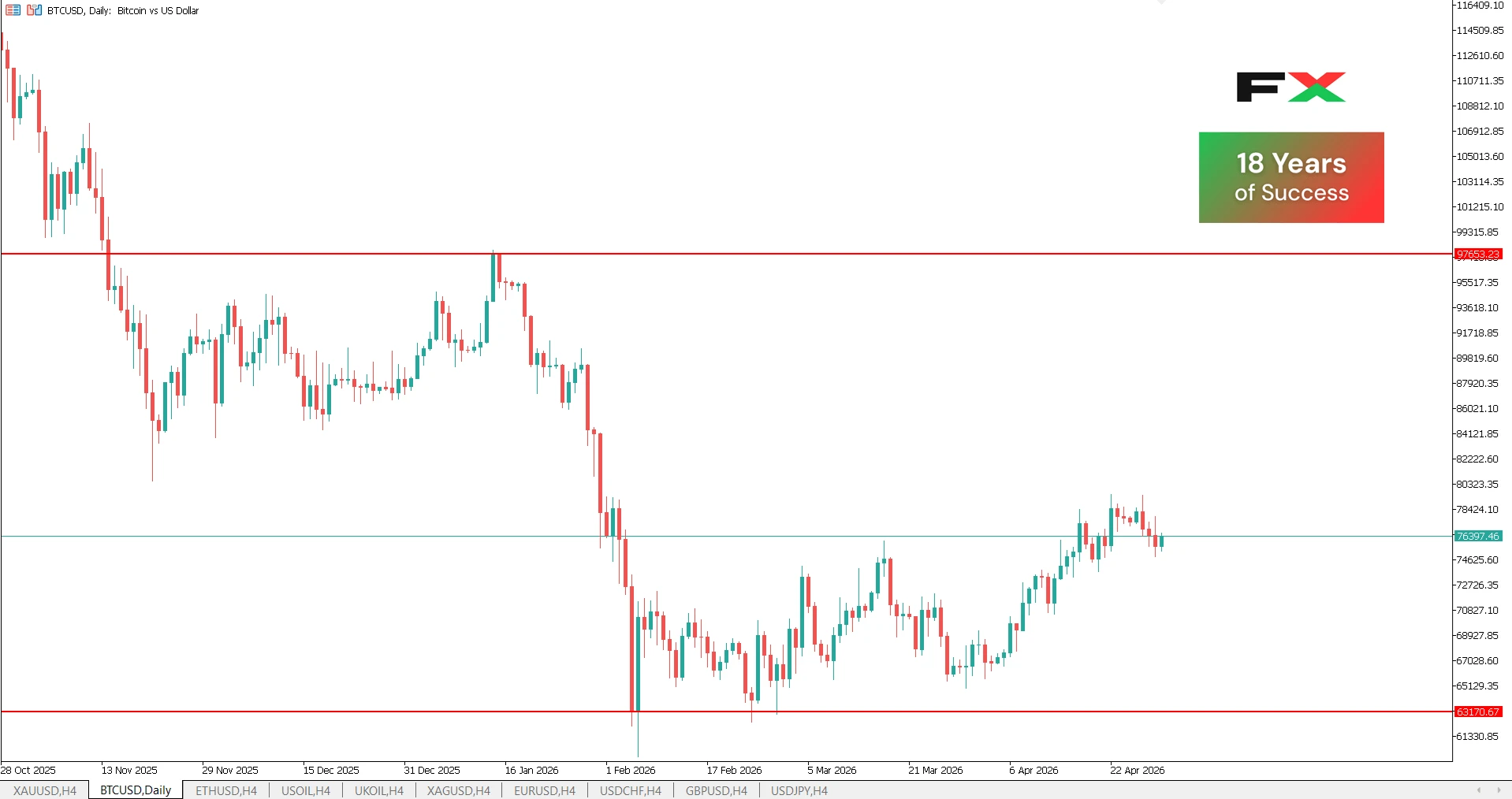
- Start with the daily chart to understand the overall market direction. Identify whether BTCUSD is trending upward, trending downward, or moving sideways. Mark the main support and resistance levels where price has previously reacted.
- Use technical tools to refine the analysis. Fibonacci retracement levels, moving averages, RSI, MACD, and volume can help confirm whether price is correcting, breaking out, or losing momentum.
- Study candle patterns near key levels. Reversal candles, strong breakout candles, long wicks, and consolidation zones can show whether buyers or sellers are gaining control.
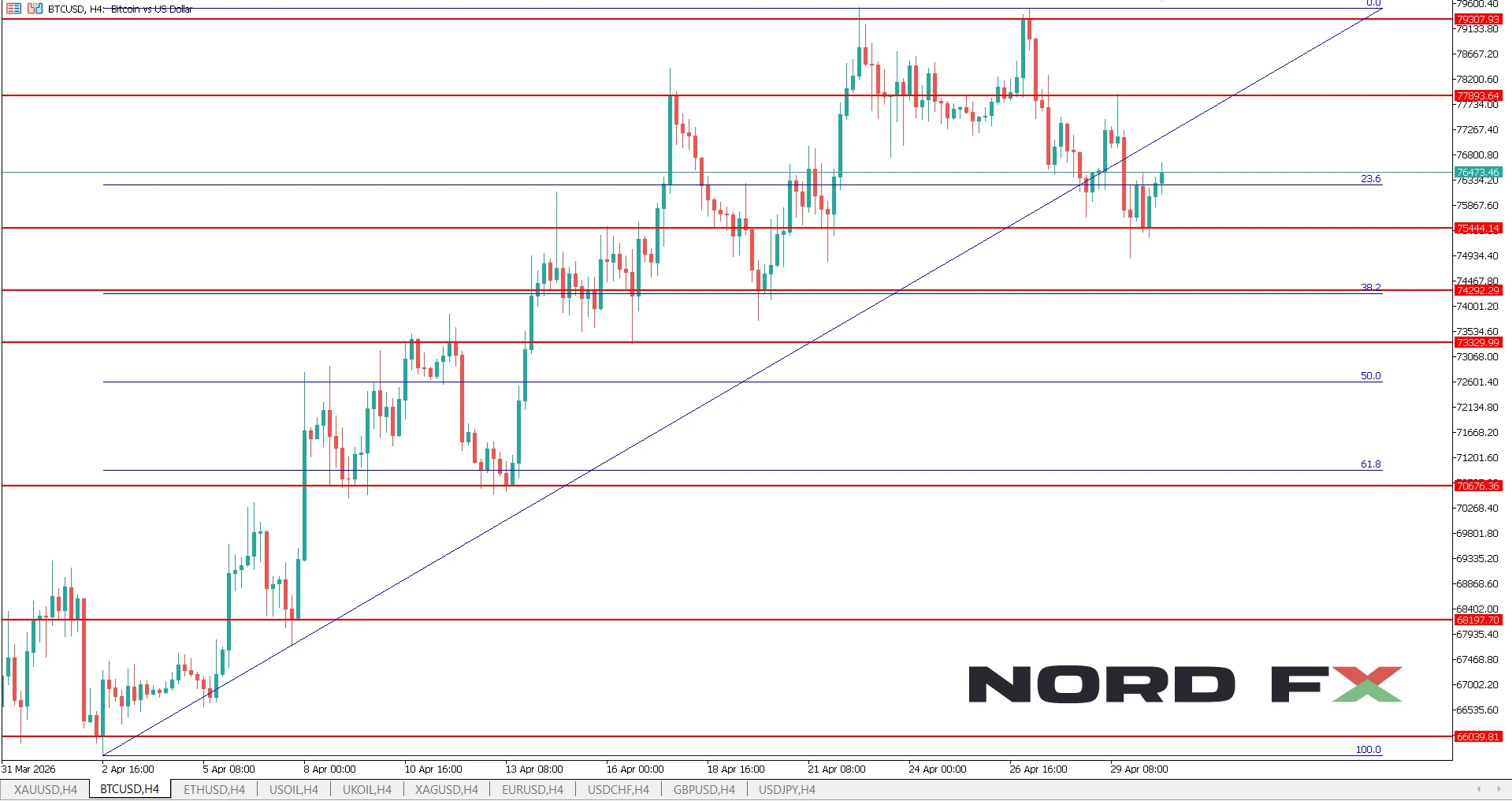
- Move to the 4-hour chart to plan the trade setup. This timeframe helps traders see medium-term structure more clearly and identify possible correction zones, breakout levels, or continuation patterns.
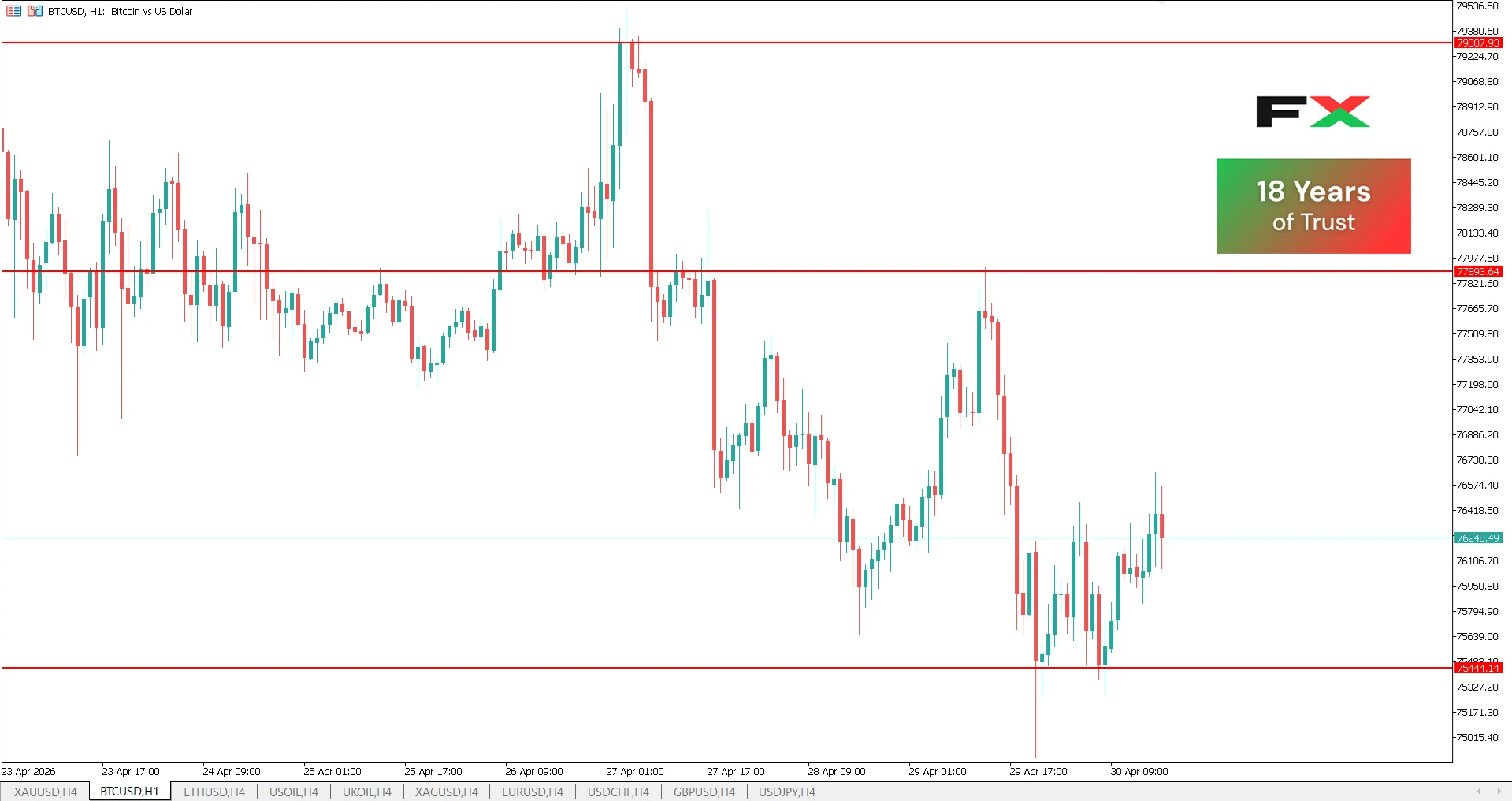
- Use the 1-hour chart for more precise entries. Instead of entering immediately, wait for confirmation such as a pullback to support, a rejection candle, a breakout retest, or improving momentum.
- Check the fundamental background. Before opening a trade, review what is currently driving Bitcoin price, such as US dollar strength, interest rate expectations, inflation data, ETF flows, institutional demand, crypto market sentiment, or major regulatory news.
- Check the economic and news calendar. Important events such as US inflation reports, Federal Reserve decisions, employment data, or major crypto-related announcements can increase BTCUSD volatility. Some traders reduce position size or avoid new entries before high-impact news.
- Define the trade conditions before entering. Decide the exact entry zone, stop-loss level, take-profit target, and reason for the trade. A good trade plan should explain what must happen for the trade to be valid.
- Wait for a correction or confirmation. Chasing fast BTCUSD moves often leads to poor entries. Patient traders usually wait for price to pull back to a key level or confirm a breakout before entering.
- Record the trade in a trading journal. Write down the setup, timeframe, entry reason, stop loss, take profit, market conditions, emotions, and final result. Over time, this helps identify strengths, weaknesses, and repeated mistakes.
Practical example
Based on the 4-hour chart provided below, BTCUSD had been in a clear uptrend, supported by a rising trendline and consistent higher highs and higher lows. However, the structure has recently changed.
Price formed two double highs near the upper resistance zone around 79,000–79,600, signaling strong selling pressure at that level. After failing to break higher, BTCUSD entered a correction phase and dropped toward the 75,400 area, which aligns with a key support level.
At the moment, price is reacting near the 23.6 Fibonacci retracement level, which often acts as an early support during corrections. However, the situation is not straightforward.
Although a full downtrend has not yet been confirmed, the market has already started printing lower lows on the 4-hour chart. This is an early warning sign that the previous uptrend structure is weakening.
This creates a transitional market phase with no clear direction:
- The uptrend has been broken due to the failure to make new highs
- A confirmed downtrend has not yet formed
- Price is moving between key levels without clear continuation
In this type of environment, the most practical decision is not to trade immediately.
Instead, a disciplined trader would:
- Wait for price to either establish a new trend (clear lower highs and lower lows for a downtrend, or a strong breakout above resistance for a continuation uptrend)
- Or observe a consolidation range forming, where clear support and resistance levels can be traded
For example, a potential buy setup would only become valid if price holds above the 75,400 support and reclaims higher levels with strong bullish confirmation. On the other hand, a sell setup would require a confirmed break below support followed by continuation with lower highs.
Until one of these scenarios becomes clear, entering the market carries higher risk due to uncertainty.
The key takeaway from this chart is that not trading is also a valid decision. Waiting for clarity helps avoid unnecessary losses and improves the quality of future trade setups.
*Not trading advice. For educational purposes only.
Major Bodies influencing the BTCUSD
Several entities influence BTCUSD price movements.
Central Banks
Interest rate decisions affect USD strength, indirectly impacting BTCUSD.
Institutional Investors
Large funds and corporations can significantly move the market when entering or exiting positions.
Governments
Regulation and policy announcements can influence market sentiment.
Crypto Exchanges
Liquidity and trading volume on major exchanges play a key role in price discovery.
Best indicators to trade Bitcoin
Technical indicators help traders analyze BTCUSD price movements.
Used to identify trends and potential reversals.
- Relative Strength Index (RSI)
Helps determine overbought and oversold conditions.
- MACD
Shows momentum and trend direction.
- Volume
Confirms the strength of price movements.
- Bollinger Bands
Indicate volatility and potential breakout points.
Fundamentals that affect BTCUSD price
BTCUSD is influenced by a mix of macroeconomic and crypto-specific factors.
- Supply and Demand
Limited Bitcoin supply combined with increasing demand drives price.
- Inflation and Interest Rates
Higher inflation or lower interest rates can increase Bitcoin demand.
- Adoption
More users and institutions adopting Bitcoin can push prices higher.
- Market Sentiment
News, social media, and investor behavior can cause rapid price changes.
- Halving Events
Bitcoin’s supply reduction events historically impact long-term price trends.
Introduction to BTCUSD trading strategy
A trading strategy provides structure and discipline, helping traders make consistent decisions instead of reacting emotionally to market movements. Without a clear strategy, it becomes difficult to manage risk or evaluate performance over time.
Trend Following Strategy
This strategy focuses on trading in the direction of the overall market trend. If BTCUSD is making higher highs and higher lows, traders look for buying opportunities. If it is making lower highs and lower lows, traders focus on selling opportunities.
Trend following works best in strong directional markets. Traders often use tools like moving averages or trendlines to confirm the trend. Entries are usually taken during pullbacks rather than at the peak of a move, which helps improve risk-to-reward ratios.
Breakout Strategy
The breakout strategy involves entering trades when price moves beyond key support or resistance levels. These levels often act as barriers, and once broken, price can move quickly due to increased momentum.
For BTCUSD, breakouts can occur after consolidation phases or near major psychological levels. Traders typically wait for confirmation, such as a strong candle close above resistance or below support, and sometimes a retest of the level before entering.
False breakouts are common, so combining this strategy with volume or momentum indicators can improve accuracy.
Range Trading
Range trading is used when BTCUSD is moving sideways between clearly defined support and resistance levels. In this case, traders aim to buy near support and sell near resistance.
This strategy is most effective in low-volatility environments where price repeatedly respects the same levels. Indicators like RSI can help identify overbought and oversold conditions within the range.
However, traders must be cautious of sudden breakouts, as a strong move outside the range can invalidate the setup.
Risk Management Rules
Risk management is a critical part of any BTCUSD trading strategy. Even the most effective strategy can fail without proper control of losses.
Key principles include:
- Risk only a small percentage of capital per trade, typically 1 to 2 percent
- Always use stop-loss orders to limit downside risk
- Avoid overtrading, especially after a series of losses
- Maintain a favorable risk-to-reward ratio, such as 1:2 or higher
Strategy Comparison Table
Strategy | Market Condition | Risk Level | Suitable For |
Trend Following | Trending | Medium | Intermediate traders |
Breakout | Volatile | High | Active traders |
Range Trading | Sideways | Low-Medium | Beginners |
BTCUSD in 2026
In 2026, BTCUSD is showing characteristics of a market in transition after a prolonged bullish phase followed by a corrective move.
Key observations:
- A strong upward trend has slowed down after reaching major resistance levels
- Price is now reacting around important support zones rather than trending cleanly
- Volatility remains relatively high, with sharp moves in both directions
This type of behavior typically indicates a reassessment phase, where the market is deciding whether to continue the long-term upward trend or shift into a deeper correction or consolidation.
During such conditions, price action often becomes less predictable, with temporary breakdowns or false breakouts before a clearer structure forms.
Traders in 2026 may focus on:
- Clearly defined support and resistance levels to understand where price is reacting
- Macroeconomic conditions affecting the strength of the US dollar, such as inflation and interest rates
- Institutional participation and capital flows, which can significantly influence medium- to long-term direction
In this environment, patience and confirmation-based trading become more important than aggressive positioning.
Start trading BTCUSD - how to do it?
If you are considering starting to trade Bitcoin, you are in the right place. BTCUSD is one of the most accessible and actively traded instruments, and multi-asset brokers like NordFX provide the ability to trade Bitcoin against the US dollar using CFDs.
One of the key advantages is margin trading. This means you do not need the full value of one Bitcoin to open a position. For example, with leverage, you may be able to control a position equivalent to 1 BTC with around 150 USD, depending on trading conditions. This allows traders to enter the market with smaller capital, but it also increases risk, so it must be used carefully.
Getting started step-by-step
- Create a personal area
The first step is to register with a broker and create your personal area. This is where you manage your accounts, deposits, and settings.
- Verify your identity
Complete the verification process by submitting the required documents. This helps secure your account and ensures full access to trading features.
- Open a trading account
Choose a trading account type and platform, typically MetaTrader 4 (MT4) or MetaTrader 5 (MT5). Both platforms provide tools for analyzing and trading BTCUSD.
- Fund your account
Deposit funds using one of the available payment methods. Start with an amount you are comfortable risking.
- Log in to the trading platform
Download and log in to your selected platform using your account credentials. From there, you can access BTCUSD charts, indicators, and trading tools.
Practice before going live
If you are new to trading, it is strongly recommended to start with a demo account. A demo allows you to trade BTCUSD in real market conditions without risking real money.
This helps you:
- Understand how the platform works
- Practice entering and managing trades
- Test strategies without financial pressure
Only after gaining confidence should you move to live trading.
Building confidence
When transitioning to a live account:
- Start with small position sizes
- Focus on simple strategies rather than complex setups
- Pay attention to how BTCUSD reacts to key levels and news
Gradual progress is more sustainable than trying to achieve quick results.
Developing discipline
Long-term success in BTCUSD trading depends on discipline:
- Follow a clear trading plan for every trade
- Avoid emotional decisions during volatile movements
- Focus on consistency rather than short-term profits
- Margin trading makes BTCUSD accessible, but it also amplifies both gains and losses. Approaching the market with patience, preparation, and controlled risk is essential.
Is BTCUSD good for trading?
BTCUSD can be a suitable trading instrument depending on the trader’s goals and experience.
When BTCUSD fits
- You are comfortable with volatility
- You want exposure to cryptocurrency markets
- You prefer flexible trading hours
When BTCUSD may not fit
- You prefer stable, low-volatility assets
- You are not prepared for rapid price swings
- You lack a clear risk management plan
Overall, BTCUSD is suitable for traders who understand its risks and approach it with discipline.
FAQs
What does BTCUSD stand for?
BTCUSD stands for Bitcoin versus US Dollar. It shows how much one Bitcoin is worth in USD at any given time.
Is BTCUSD the same as buying Bitcoin?
Not always. In spot trading, you buy actual Bitcoin. In CFD trading, you only speculate on price movements without owning the asset.
Why is BTCUSD so volatile?
BTCUSD is volatile because it is influenced by market sentiment, limited supply, and relatively lower liquidity compared to traditional forex markets.
Can beginners trade BTCUSD?
Yes, beginners can trade BTCUSD, but they should start with a demo account, use simple strategies, and focus on risk management.
What time is best to trade BTCUSD?
BTCUSD trades 24/7, but higher activity usually occurs when major financial markets overlap, increasing liquidity and volatility.
What affects BTCUSD the most?
Major factors include supply and demand, macroeconomic conditions, institutional investment, and regulatory developments.
Is BTCUSD better than forex trading?
It depends on the trader. BTCUSD offers higher volatility and potential opportunities, while forex pairs typically offer more stability.
How much money do you need to trade BTCUSD?
The required amount depends on the platform, but many allow trading with small deposits. It is advisable to start with an amount you can afford to risk.
Meet the Author
Vanessa Polson is a marketing manager at NordFX with over twelve years of experience in online marketing within the financial services industry. She has developed and executed data-driven campaigns across search, social, and display channels in in-house environments. Her work focuses on translating complex financial products and trading tools into clear, practical educational content, giving her a broad and well-rounded view of the global trading landscape.
Connect with Vanessa on LinkedIn.
Повернутися Повернутися